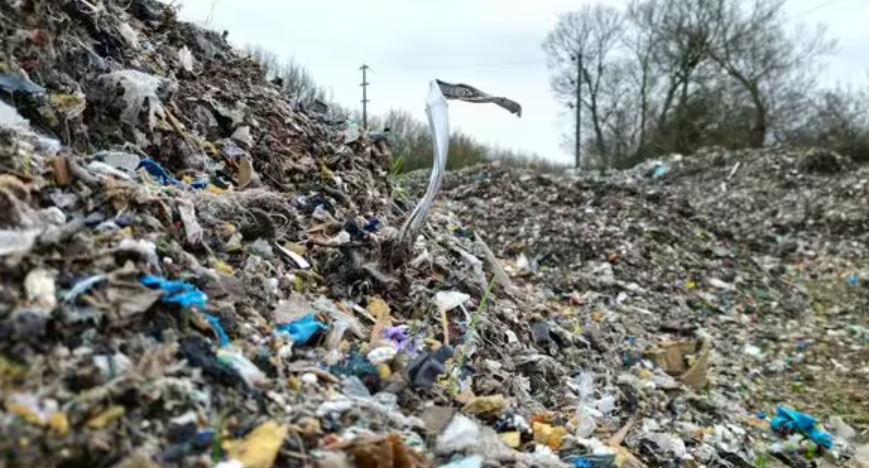


The government has called on councils to take action on fly tipping (Image: Getty)
The Government has called for flytippers’ cars to be crushed as activists say the UK is suffocating under piles of rubbish. It has recommended councils to use video evidence to name and shame fly-tippers on social media and share videos of their vehicles being crushed.
Mary Creagh, the minister for nature, warned offenders not to be surprised if their car “ends up on the scrapheap”. The guidance advised councils to use “overt and covert” surveillance techniques such as drones and automatic number plate recognition to catch criminals red-handed, reports The Times.

A huge mound of dumped rubbish appeared in Oxfordshire (Image: Getty)
The Government wants tough action, with fly-tipping and littering costing the UK economy about £1billion annually, however, activist groups have highlighted that cash-strapped councils face financial barriers to targeting criminals.
A council can seize and search a vehicle if an enforcement officer reasonably believes it has been used for fly-tipping. Some 139 vehicles were seized by council enforcement officers in 41 local authorities in 2024-25.
However, it must cover all related costs. This includes seizing and storing the vehicle, disposing of it, and paying any legal costs if the owner seeks to have it returned.
John Read, founder and managing director of Clean Up Britain, said there is little chance of being caught, and the sentences are ridiculously low.
“To be effective, we have to create real jeopardy and fear in the minds of fly-tippers,” he said. “We need to start getting very tough on fly-tippers before our country is buried even more under a tsunami of waste.”
He called for higher penalties, an independent enforcement body, and for the financial barriers to prosecution for councils to be removed.

Councils can issue fixed penalty notices for fly tipping up to £1,000 (Image: Getty)
Councils dealt with 1.26 million fly-tipping incidents last year, an increase of 9% from the year before. However, few were put through the courts.
Between 2024-25, some 1,250 court fines were issued, at an average of £538.40 each. But if councils follow the court route, they bear the costs of investigation and prosecution, while all money goes to the treasury.
In comparison, when councils issue penalty notices, the money goes back into their coffers. The number of fixed-penalty notices issued during the time period was much higher, at around 69,000, and the maximum value was capped at £1,000.
One of the most striking recent examples of flytipping was a 150-metre-long stretch of plastic waste dumped along the banks of the River Cherwell last year.
On a more local scale, farmers are among the worst affected. A survey by the Country Land and Business Association found that almost 75% of farmers who responded experienced fly-tipping each year, with some targeted several times a month.

Farmers are among the worst impacted by flytipping (Image: Getty)
Despite this, many incidents go unreported because landowners say councils can require them to clear the waste themselves, leaving victims of crime facing cleaning bills.
On average, each fly-tipping incident costs about £1,000 to clean up. Some 85% of affected farmers said they had invested in security measures such as CCTV, lighting and fencing to deter offenders.
Some councils are now trialling tougher approaches, including using cameras to catch fly-tippers in the act and accepting dashcam footage from members of the public to help identify those responsible.
Emma Reynolds, the environment secretary, said: “By increasing the EA’s enforcement budget by over 50 per cent to £15.6 million, we’re investing in cutting‑edge technology that allows us to shut down illegal operators faster and more effectively.”