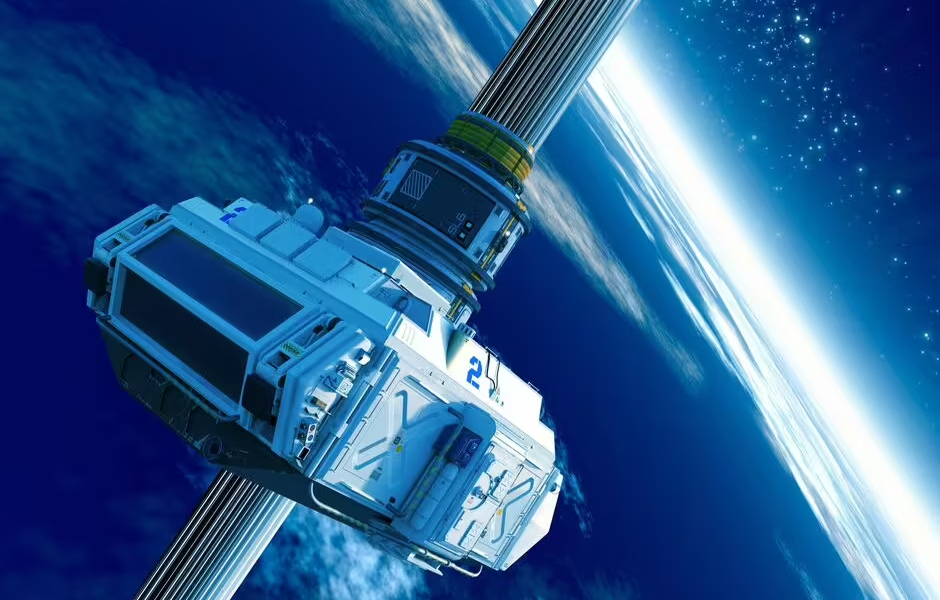


Tom Cheesewright says the next frontier of space travel and exploration will be a space elevator (Image: Getty Images/Science Photo Library RF)
Remember when we thought the future would mean wearing Bacofoil suits and driving to work in a Jetsons-style aero-car? The 21st century, of course, didn’t quite turn out how the popular futuristic children’s cartoon predicted – but in many ways it looks wackier than we could have imagined.
Now leading futurologist and author Tom Cheesewright, who advises companies on how to plan and prepare for the future, has predicted the top ten scientific and technological breakthroughs we can expect to see by 2050.
“Human beings have a deep-seated ingenuity, and while I understand the future can be scary, we have every reason to be hopeful,” he says.
In fact, Cheesewright, who has a degree in mechatronic engineering, believes the next 24 years have the potential to be the greatest era of progress in human history.
His top ten inventions for 2050 come as just one in six people say they feel optimistic about the future of the world, according to new research from Zurich Insurance.
Some 63% of respondents who are old enough to remember the turn of the century say they are gloomier now than they were 25 years ago.
“It’s become fashionable to bemoan a future dominated by AI, robotics and relentless technological change, but really, we have a lot to look forward to,” says Cheesewright. “Here are the key breakthroughs that I am most excited about as we look towards the second half of the 21st century.”
Space elevator
“A space elevator is something man has been imagining since the 1960s.
“The next frontier of space travel and exploration will finally see the construction of the world’s first space elevator, a towering structure with the dual purpose of carrying both cargo and passengers into orbit.
“Rockets are incredibly expensive and create a huge amount of greenhouse emissions. Every space agency in the world is currently trying to work out how to build an elevator to space and what can be used for the cables.” (Graphene and carbon nanotubes, apparently)
“Quieter, cleaner and less dramatic than a rocket ship, the eventual ascent will take a couple of weeks, offering a sustainable way to escape Earth’s pull, with unparalleled views along the way.”

Conceptual illustration showing the 3D printing of a human organ. (Image: Getty Images/Science Photo Library RF)
Personal AI as a health coach
“Preventative medicine will become the norm. Genetic screening will be widely available and followed by risk-based testing and targeted interventions, so many issues will be addressed before they become illnesses.
“Personalised, data-led care paths, supported by constant biometric and personal AIs will really be able to help people stick to professional health advice, planning meals, building habits, and supporting treatment. Life expectancy has risen modestly, but the big win is quality of life in later years: more health, productivity, and connection.”
Android and robot room-mates
“Domestic androids and robot companions will be common, though not universal. They’re going to be compact when idle, often bought on finance or subscription, and gain new capabilities through software.
“Most sync with the user’s personal AI and will handle routine chores such as laundry, cleaning, whilst also offering companionship. Top-end models can cook well! With more people living alone and longer in the future an android can provide some companionship and help with mundane household tasks as older people become less mobile – even if it can’t replace real human interaction.”
Smart glasses instead of smart screens
“It might be hard to imagine now, but we’re standing at the edge of the last era of handheld devices. Personal tech will have largely disappeared. Where 2025 was device-centric, 2050 is environment-centric. AI will anticipate needs, so buttons and switches will become rarer (though many people will keep manual overrides).
“In the next 25 years, smart glasses will become the dominant tool used for seeing and communicating with the world around us. Most viewing and communication will happen through smart glasses.
“They layer augmented reality onto the physical world with people, objects, and tools you can interact with. Voice and gesture are the main inputs, with AI smoothing out errors. Virtual keyboards will still exist for heavy writing but aren’t central anymore.”
Flat screen TVs as thin as paper
“Remember when it was predicted TVs would become as thin as 5cm? Screens around the house will also continue shrinking until they are barely noticeable, with TVs becoming as thin as wallpaper, painted onto surfaces without sacrificing a single pixel of ultra-high-resolution clarity. At the moment, it’s just about making sure that technology is reliable enough that quality isn’t sacrificed.”

Futurologist Tom Cheesewright has made a series of science-based predictions for 2050 (Image: -)
Bio-printed organs
“Ready access to 3D bio-printers will see complex organs and even eyes produced using patients’ own cells, with zero rejection risks and no waiting times for matching donors.
“We can already do this with cartilage and simple tissue formations like ears, noses and blood vessels – but imagine being able to do it with more complex organs like hearts, kidneys and livers? We could eventually see the end of transplant lists, which will have a huge impact on many people’s quality of life.”
Lab grown meat
“The rate we eat meat will continue to fall, as alternative sources of protein become more common, and the remaining carnivores opt for quality over quantity. Lab-grown meat will be cheap enough and tasty enough to be a viable option for those hoping to reduce meat consumption on ethical grounds.”
Lab-grown meat or cultivated meat is cell based meat or simulated muscle tissue created with a scaffolding of proteins and other materials supporting real animal cells. It is estimated that by 2040, 35% of the global meat market will be lab grown.”
Deception studies and virtual field trips
“Media literacy will become a core subject. Deception studies will teach students to spot AI-generated fakes and deepfakes, building resilience, analytical skill, and ethical awareness. The aim is to restore the ability to identify truth, not just to fuel scepticism.
“High-fidelity VR will bring lived experiences into the classroom: Students visit the Jurassic era to study ecosystems or practise Latin in simulated Roman towns. These trips count like fieldwork and make learning stick.”
Smarter money automation
“Spending will be easier with biometrics, delegated AIs, digital currencies, and abundant credit. Personal AIs will act like financial stewards: they optimise bills and subscriptions, switch banks and utilities for daily savings, and negotiate with retailer AIs. Crucially, they also follow your values, not just price, so your purchases align with what matters to you.
“Insurance will be priced in real time. Location, behaviour, health, and activity data feed continuous repricing engines that match premiums to moment-by-moment risk.
“People will trade some privacy for lower costs, while regulators focus on fairness, transparency, and recourse.”
 Get More of Our News on Google
Set Daily Express as a ‘Preferred Source’ to get quicker access to the news you value.

- To read Tom Cheesewright’s predictions in full, visit zurich.co.uk/meet-tomorrow

Smart glasses could become the dominant tool used for seeing and communicating with the world around us. (Image: Getty Images)