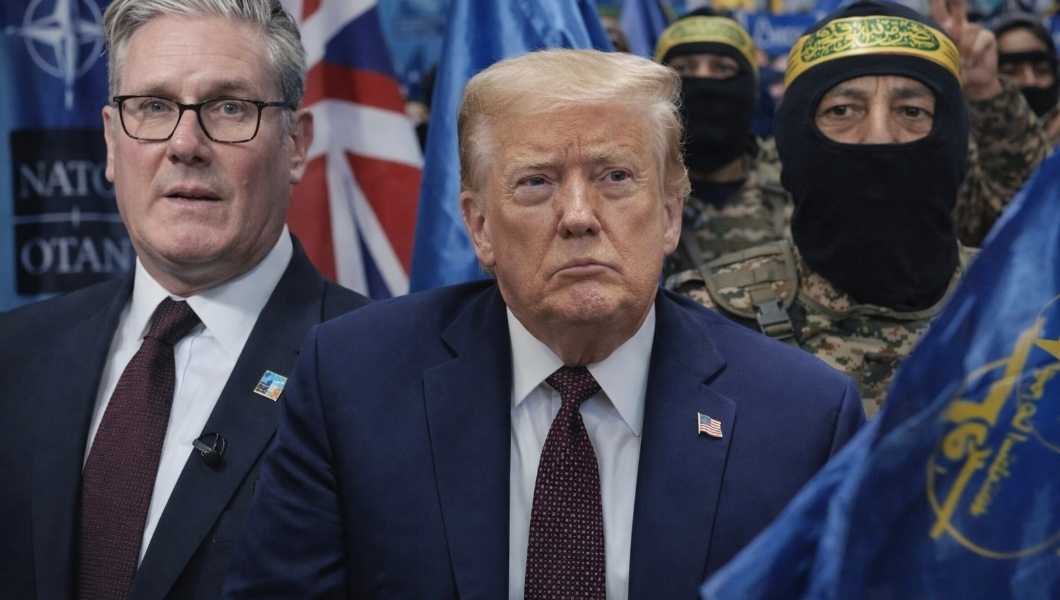

Summary: Sir Keir Starmer’s Government is refusing to proscribe Iran’s Islamic Revolutionary Guard Corps (IRGC) as a terrorist organisation, despite fresh pressure from Washington and renewed calls from Conservatives, Reform UK and even senior Labour figures. Ministers insist sanctions are being used “to the full extent” and cite legal advice warning proscription is not designed for foreign state bodies.
Starmer holds the line on banning the IRGC
Downing Street is refusing to proscribe the IRGC, Iran’s powerful security and military force, even as protests in Iran intensify and international pressure builds.
Ministers argue that the UK has already sanctioned key figures and entities, and that proscription is not the right tool for a state-linked organisation.
“We did a review… and he came back and said the idea of proscribing like we do for domestic organisations isn’t appropriate for a foreign state organisation.”
Peter Kyle, Business Secretary
That stance is now colliding with political reality: the public can see violence on the streets, and allies are openly asking why Britain is hesitating.
The US piles on: “stating the obvious”
The United States has joined calls for the UK to formally designate the IRGC as a terrorist organisation, describing such a move as self-evident.
Donald Trump’s first administration designated the IRGC as a Foreign Terrorist Organisation in April 2019, setting a precedent that critics say Britain should have followed years ago.
“Designating the IRGC as a terrorist organisation is merely stating the obvious.”
US State Department spokesman (reported)
This matters because it frames Starmer’s position not as “cautious diplomacy” but as Britain lagging behind its closest security partner.
Labour’s legal shield: sanctions, not proscription
Labour’s front bench is leaning heavily on the advice of the independent reviewer of terror legislation, Jonathan Hall, who previously warned that proscription is built for non-state groups.
The Government’s argument is simple: calling the IRGC a “terror group” through proscription could blow up diplomatic ties with Tehran and complicate state-to-state measures.
“No… You can see we’ve already used the sanctions against Iran to the full extent we can.”
Peter Kyle, Business Secretary
Hall has suggested an alternative approach: a new “classification power” that mirrors proscription but is designed for state bodies.
In plain English: ministers want a new label that sounds tough without triggering the full legal and diplomatic consequences of proscription.
Pressure at home: Reform, Tories and Labour voices converge
Calls to ban the IRGC are now coming from multiple directions, including Labour peers and prominent figures usually careful about national security language.
Proscription would make it a criminal offence to belong to the IRGC or to invite support for it, and would give law enforcement sharper tools around fundraising and propaganda.
“The IRGC are not only terrorising their own people but running a terrorist and criminal network throughout the world… The Government now need to get off the fence and proscribe the IRGC.”
Lord Spellar (Labour), reported
From the Right, the argument is even more blunt: Britain cannot pretend a regime-backed militia is something that can be managed with polite statements and a spreadsheet of sanctions.
“Any claim… that by not proscribing the IRGC gives them diplomatic influence is simply not borne out by events… It is time… by proscribing the IRGC today.”
Sir Iain Duncan Smith, reported
Reform UK has backed proscription, with Nigel Farage urging Starmer to “stand up to the ayatollah”. For Reform supporters, this fits a wider pattern: Labour being soft where it should be firm.
Kemi Badenoch raises the stakes
Conservative leader Kemi Badenoch has described Iran as a direct threat to Britain and signalled that national interest comes first when it comes to security decisions.
Her remarks tap into a wider public frustration: if a hostile regime is linked to plots or intimidation, why is Britain still arguing about labels?
“The calculation always has to be about our national interest.”
Kemi Badenoch, reported
Tom Tugendhat, a former security minister, has also said he believed the UK should have proscribed the IRGC, arguing it is a standalone organisation rather than simply “the state”.
What proscription would actually change in the UK
This debate is not just theatre. Proscription is a hard legal step that can reshape enforcement, deterrence and policing priorities.
It can criminalise membership, clamp down on organising and fundraising, and provide clearer grounds to disrupt networks operating here.
Critics of Starmer’s stance say sanctions alone are too slow and too easily sidestepped, while proscription is unmistakable.
Supporters of the Government’s position respond that proscription was never designed for state institutions, and that the UK needs a bespoke power that can be used without shredding diplomatic channels.
The politics: Labour’s “careful” approach meets a hard world
Starmer’s pitch has always been “serious, responsible, grown-up government”. The problem is that hostile states do not care about the tone of your press release.
When the US is publicly urging action, and domestic pressure is coming from Reform UK, Conservatives and Labour peers alike, “we’ve sanctioned to the full extent” starts to sound like a holding statement.
For Brexit-minded voters, there’s a wider irritation too: Britain is supposed to be a sovereign country capable of decisive action, not one constantly trapped in process and review.
The ECHR angle also hangs over the background of almost every security argument in modern Britain. Critics increasingly believe legal constraints and risk-avoidance have turned national security into a paperwork exercise.
Whether you agree or not, that is the political weather Starmer is walking into.
Where this goes next
Any eventual decision on proscription sits with the Home Secretary, Shabana Mahmood, because terror legislation runs through the Home Office.
Ministers will also face questions in Parliament as peers and MPs push for a clear explanation: if the IRGC is a threat, why won’t the Government use the strongest label available?
Downing Street may try to split the difference by pursuing a new “classification power” that looks like proscription in practice, without the diplomatic shockwave.
But politically, the longer Labour refuses to move, the easier it is for opponents to paint the Government as hesitant when the moment demands clarity.
Starmer’s Greenland stance explodes Chagos contradiction as islanders protest surrender deal

- Chagossians say they were never consulted on sovereignty transfer
- UK to pay up to £30bn leasing back its own strategic base
- UN warns deal breaches Chagossian human rights
The Prime Minister has been crystal clear on Greenland. Sovereignty, he says, is for the people of Greenland and Denmark to decide. No outside pressure. No arm-twisting. No shortcuts.
Yet when it comes to the Chagos Islands, that principle suddenly vanishes. Britain is handing sovereignty to Mauritius without asking the Chagossian people at all.
In Parliament Square, anger boiled over. Chagossian campaigner Vanessa Mandarin told GB News: “We want to remain British.” Her family, like thousands of others, was forcibly removed decades ago. Now they face losing their homeland again, this time by ministerial pen.
The deal, signed last May, hands sovereignty to Mauritius while leasing back Diego Garcia, home to a vital UK-US military base, at a cost of roughly £100m a year. Over a century, estimates run as high as £30bn. Britain pays. Britain loses sovereignty.
Legal challenges argue the Government breached basic human rights by refusing consultation. The irony is hard to miss. This is a Labour government led by a former human rights lawyer, accused of sidelining the very people affected.
The House of Lords has already inflicted defeats, backing amendments demanding safeguards and scrutiny. Former Northern Ireland First Minister Baroness Foster has asked the obvious question: why do Greenlanders get self-determination, but Chagossians do not?
Even the United Nations Committee on Racial Discrimination has raised “grave concerns”, warning the deal risks perpetuating longstanding rights violations. Labour insists its hands were tied by a 2019 advisory opinion from the UN court in The Hague. Advisory, not binding.
With geopolitics tightening and the US watching closely, some hope Donald Trump may yet intervene on security grounds. For now, Chagossians are left asking why their voice matters less than everyone else’s.
“He Is Responsible”: Reform UK’s Laila Cunningham Blames Khan for London Crime Surge

Summary: Reform UK’s London mayoral candidate Laila Cunningham used a party rally speech to accuse Mayor Sadiq Khan of presiding over a worsening crime situation in the capital, arguing that Londoners have become “accustomed” to serious violence and that policing priorities have drifted away from frontline visibility.
What Laila Cunningham said at the Reform UK London rally
Speaking at a Reform UK rally in London, Cunningham claimed public fear has risen because the city is “more dangerous” and argued that repeated reports of violence are being treated as routine.
“Londoners are scared because London is more dangerous… we’ve become accustomed to it. That’s not normal.”
She referenced reports of multiple stabbings on Edgware Road “this week” and said the public reaction is increasingly resigned.
Cunningham also attacked the Mayor’s public messaging on crime, saying it conflicted with what she described as residents’ lived experience.
“And he still tells us, ‘My fight against crime is working.’”
Claims about policing, stop and search, and priorities
Cunningham’s speech focused on policing visibility and the use of stop and search, describing visible patrols as “basically nonexistent” and claiming stop and search had been “halved.”
“Any of you see a police when you walk down the street? Stop and search halved…”
She argued that stop and search plays a role in preventing knife crime, and suggested reductions would be felt on the streets.
Cunningham also criticised what she framed as a shift in police activity away from crime prevention.
“He diverts officers into policing tweets. Mums and pops at home instead of the streets.”
Direct accountability: Khan’s role and the City Hall debate
The sharpest section of Cunningham’s remarks was aimed at accountability, arguing the Mayor is not simply observing events but bears responsibility through City Hall’s oversight structures.
“He is the Police and Crime Commissioner. He appoints the Met Commissioner. He sets the priorities. He signs off the budget.”
She concluded that the “chaos” and “danger” were “because of him,” placing responsibility on the Mayor’s leadership and policing governance.
In London politics, the Mayor’s policing role is often a focal point because City Hall sets the strategic direction for policing and holds senior leadership to account, while operational decisions remain with the Metropolitan Police.
Identity politics allegation and the wider campaign framing
Cunningham also alleged that criticism of crime levels is being dismissed through identity-based arguments, saying this approach is unfair to victims and residents concerned about safety.
“He calls us racist… That’s what it all comes down to for him. Identity politics, and that’s an insult to victims.”
This line of attack signals how Reform UK may seek to frame the London contest: linking public safety to governance, messaging, and institutional priorities rather than treating crime as a purely policing problem.
The comments are likely to intensify debate over policing tactics, performance measures, and whether Londoners feel safer, issues that typically cut across party lines but become highly charged during mayoral campaigns.