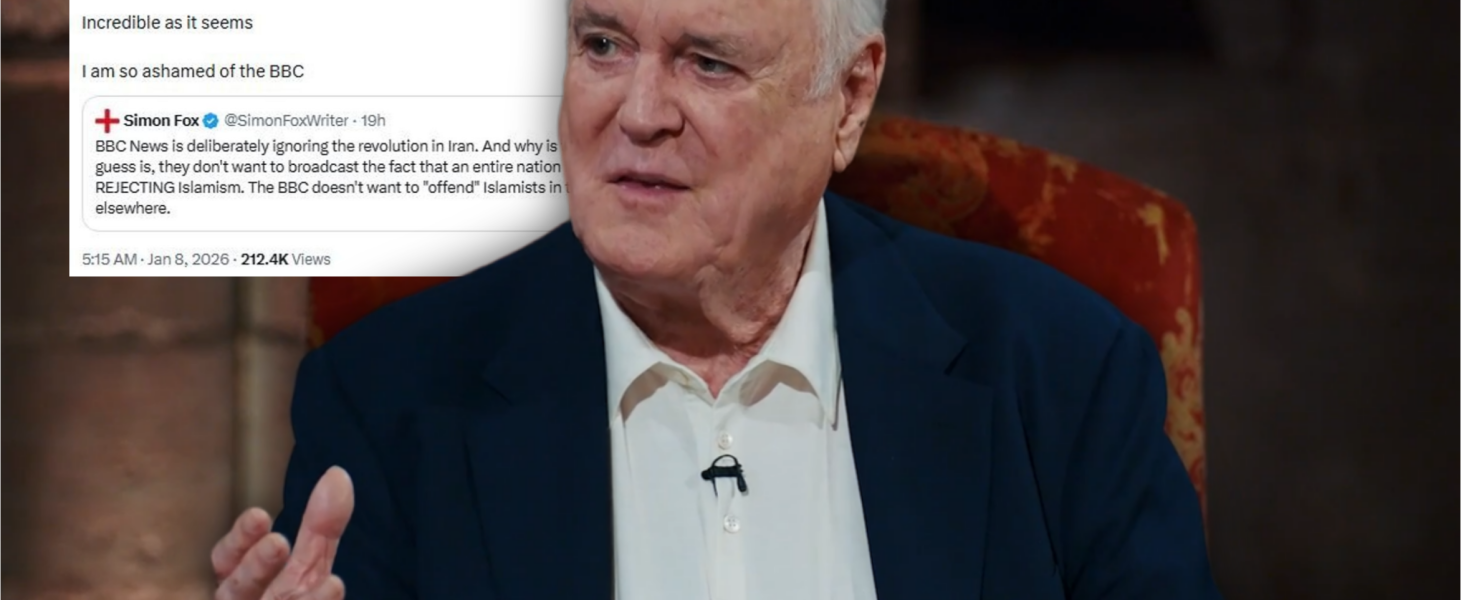

John Cleese has launched a blistering attack on the BBC, accusing it of failing to properly cover mass protests in Iran and being more concerned with not offending Islamist sensitivities in the UK.
The criticism comes as Iran faces widespread unrest driven by soaring inflation, food prices rising by more than 70 per cent, corruption, civil rights abuses and deepening energy shortages. Many see the protests as one of the most serious challenges yet to the Islamic Republic.
Despite the scale of the moment, critics say the BBC has treated events in Iran as a side story. The Israeli Embassy previously accused the broadcaster of near-total silence, while Iranian journalists have claimed the protests do not fit the BBC’s preferred narrative.
Cleese reignited the row by reposting claims that the BBC was deliberately downplaying events to avoid offending Islamists in Britain. He responded bluntly: “This is the best explanation I’ve read so far. Incredible as it seems. I am so ashamed of the BBC.”

The actor later shared footage of the BBC News homepage, highlighting lighter celebrity stories while Iran protests were absent. His verdict was savage. Cleese accused BBC News staff of lacking the ability to distinguish between “the utterly trivial and really significant,” branding the organisation “breathtakingly rudderless”.
Cleese also amplified comments from J K Rowling, who praised the bravery of Iranian protesters and described them as a rare light in a dark global moment.
The BBC has firmly rejected the accusations. A spokesperson insisted coverage of Iran has appeared daily across all platforms, including English-language bulletins and BBC News Persian. The BBC News press team even published screenshots to prove its case.
But for critics, the damage is already done. When a national broadcaster must repeatedly insist it is doing its job, public confidence is clearly eroding.
‘Democratic Outrage’: Zia Yusuf Accuses Starmer of Binding Britain to EU with ‘Farage Clause’

Summary: Former Reform UK chairman Zia Yusuf has accused Sir Keir Starmer of trying to “bind” future governments into closer EU alignment, calling it a “democratic outrage” and responding to reports of a so-called “Farage clause” with a promise of hardline counter-measures if Reform enters government.
Zia Yusuf: “It’s a democratic outrage” over alleged “Farage clause”
Former Reform UK chairman Zia Yusuf has launched a broadside at the Prime Minister amid reports that EU negotiators have discussed a potential mechanism to discourage any future UK government from unwinding a Starmer-era EU “reset”.
In a TV exchange, Yusuf argued that such a move would undermine democratic accountability by attempting to lock in decisions beyond a single Parliament.
“It’s a democratic outrage. That’s what it is. Keir Starmer is very sneakily dragging the UK back into the European Union… and now he’s negotiating something that the EU is literally calling… a Farage Clause.”
Yusuf framed the issue as sovereignty first: Parliament remains supreme, and no external institution should be able to penalise a future government for changing course.
“Our parliament in the UK is sovereign. Nobody, including, and especially, foreign bureaucrats will bind a future reform government or Nigel Farage as Prime Minister.”
He acknowledged trade benefits, then rejected the “lock-in” principle
Notably, Yusuf briefly accepted the argument that stability can reduce friction for exporters, referencing a potential veterinary-style agreement that could cut red tape for food and agricultural trade.
But he then insisted that any practical benefits do not justify constraints that outlive voters’ consent.
“In some respect, that certainty is a good thing… It would basically slash red tape for British food and for exporters.”
That is the core political dividing line: smoother trade processes versus the constitutional question of who ultimately controls the direction of UK law and policy.
“We will give them a Farage clause”: welfare and France funding claims
Yusuf then pivoted to what he described as Reform’s “Farage clause” response: tougher decisions on welfare eligibility and overseas payments.
He claimed EU nationals receive large sums through Universal Credit, and said a Reform government would stop such payments “on day one”. These figures were presented as political claims in the exchange and would require independent verification to be treated as established fact.
“How about terminating all welfare payments to foreign nationals including EU nationals? … people watching this show, are paying £6 billion a year in welfare payments, just Universal Credit payments alone, to EU nationals every year. We’ll stop that on day one.”
He also referenced payments made to France linked to efforts to deter Channel crossings, describing them as ineffective and demanding money be returned, again as part of a hard-nosed negotiating posture.
“How about we ask Macron in France to give back to us the £800 million that the Tories and Labour have paid them to supposedly stop the boats?”
Reform’s wider attack line: Labour, “the uni-party”, and sovereignty
Yusuf widened his argument into a familiar Reform critique: that Labour and Conservatives have both enabled concessions to supranational rules and courts, and that Britain needs a government prepared to prioritise national interest in negotiations.
He also attacked the Prime Minister’s approach to democracy more broadly, accusing him of centralising power and ignoring public consent.
“What this country needs badly is a leader… a prime minister who’s actually gonna stick up and negotiate for British people… not foreign governments and not foreign courts.”
Analysis: the real fight is about “who decides”
This row is not just technical trade policy. It is a political battle over whether any EU “reset” becomes effectively permanent, insulated from future elections.
For Reform, that framing is electoral gold: Brexit was sold as control, and anything resembling legal or financial penalties for changing course will be branded as the exact opposite.
For Labour, the counter-argument will be stability, predictability and reduced friction for business. But the government will struggle if voters believe the price is democratic lock-in or renewed deference to EU rules.
Starmer in Arctic Troop Talks as NATO Scrambles to Calm Trump Over Greenland
 Summary: Downing Street has held early talks with European allies about boosting security in the Arctic, including a potential NATO-backed presence in Greenland, amid President Donald Trump’s claims the island is vulnerable to Russian and Chinese pressure.
UK and allies explore a stronger Arctic posture
UK officials have been in discussions with European counterparts about how NATO could reinforce security around Greenland, the strategically placed Arctic territory that is self-governing but part of the Kingdom of Denmark.
The talks, reported as being at an early stage, include ideas ranging from a more permanent troop presence to time-limited exercises, enhanced surveillance, intelligence sharing, and capability development.
Why Greenland has become the new flashpoint
Greenland’s location gives it outsized importance for North Atlantic and Arctic defence planning, particularly as polar routes and military access become more contested.
It is also rich in minerals linked to modern supply chains, including rare earths used in advanced technology, adding an economic dimension to the security debate.
Trump’s pressure and NATO’s dilemma
President Trump has framed Greenland as a national security issue, arguing Washington cannot accept a growing Russian or Chinese footprint in the region.
“We’re not going to have Russia or China as a neighbour.”
He has also suggested the US could pursue control of the island by agreement, and has not ruled out more coercive options, creating a serious political strain inside an alliance built on mutual trust and sovereignty.
Starmer’s message: deterrence, but through NATO
Government sources have indicated the Prime Minister views Russia’s Arctic posture as a genuine concern, and that the UK wants any enhanced presence to sit under NATO’s collective framework rather than unilateral moves.
“We share President Trump’s view… Russia’s growing aggression… must be deterred.”
Officials have stressed that discussions are ongoing and that the UK would not pre-empt NATO’s formal decision-making.
What a mission could look like in practice
Options described in reporting include a mix of personnel, naval patrols, and air assets, alongside training deployments and upgraded monitoring of Arctic approaches.
Separately, the UK has already been increasing its cold-weather readiness with Arctic-focused training, including Royal Marines deployments to Norway as part of NATO activity. This sits within a wider push among allies to prove they can operate in harsh conditions and reinforce the “High North” quickly.
European leverage: money, sanctions, and basing threats
European capitals are also looking at ways to discourage US escalation by offering Trump a “win” on burden-sharing: more European capability in the Arctic, paid for and staffed by Europeans, under NATO branding.
Some reports suggest the European Union has discussed retaliatory economic measures if Washington rejects a NATO-based compromise, including potential restrictions on major US firms operating in Europe. Such ideas, if pursued, would represent an unusually sharp turn in transatlantic politics.
The awkward question: can Britain actually deliver?
Alongside the diplomatic manoeuvring sits a practical concern: whether the UK can sustain meaningful high-end deployments while managing stretched forces and competing priorities.
Retired senior officers and defence analysts have recently warned that capability gaps and procurement problems risk widening the gap between political promises and military capacity, especially in demanding environments like the Arctic.
What happens next
NATO military planners are expected to examine what additional steps could be taken to reinforce Arctic security, while US and Danish diplomacy continues, including planned high-level meetings in the coming days.
For Starmer, the political balancing act is clear: reassure an unpredictable White House, avoid humiliating Denmark, and keep NATO unified, all while proving the UK can still pull its weight where it counts.
Hotel Migrants Face Spring Evictions as Home Office Tightens Asylum Support Rules

Summary: The Home Office is reported to be preparing a spring crackdown to remove hotel accommodation and weekly support from certain asylum seekers, as ministers push to close more asylum hotels and cut costs. The plans would target people deemed able to support themselves, those breaching rules, and those refusing removal directions.
Home Office plans to begin hotel evictions in spring
The Home Office will reportedly start evicting some asylum seekers from hotels in the spring, as the Government attempts to reduce reliance on taxpayer-funded accommodation.
According to reports, the Home Secretary, Shabana Mahmood, wants faster hotel closures and tighter rules on who qualifies for state-funded support.
Who could lose accommodation and weekly payments
The reported proposals would focus on asylum seekers assessed as able to support themselves financially but choosing not to.
Other groups said to be in scope include people who have a right to work, those who break the law or work illegally, and those who refuse to comply with an order to leave the UK.
The central policy shift would be to end the Government’s automatic duty to support all destitute asylum seekers, replacing it with more conditional support tied to behaviour and eligibility.
How many people are affected
The changes are expected to allow the Home Office to withdraw support from thousands of people currently receiving payments or accommodation.
Reports cite a total of 111,651 people receiving some form of Home Office support, while around 36,000 asylum seekers were housed in hotels as of the latest available figures.
The Home Office has said fewer than 200 hotels are now being used for asylum accommodation.
What else is being considered
Ministers are also reported to be looking at alternative accommodation to replace hotels, including former military barracks and houses of multiple occupation.
Diplomatically, the Government is said to be considering expanding “one-in, one-out” returns arrangements with France and pursuing a new agreement with Germany.
Separately, asylum seekers from Syria could face removals if ministers continue to judge conditions safer following the fall of the Assad regime at the end of 2024.
Political messaging and border numbers
The reported plans land amid pressure on Labour to show visible results on small-boat crossings and the overall asylum bill.
“The Home Secretary is a woman in a hurry. She is working tirelessly to introduce these reforms to restore order and control to our borders.”
Official figures cited in reporting put last year’s small-boat crossings at 41,472, the second-highest annual total on record, below the 2022 peak of 45,774.
So far in 2026, reports cite 32 arrivals in a single boat on January 5.
What happens next
Further hotel closures are reported to be expected by April, with the Home Office aiming to demonstrate progress over the coming months.
However, even under tougher eligibility rules, many asylum seekers are still likely to remain entitled to support, meaning the overall impact will depend on how eligibility tests are defined and enforced.