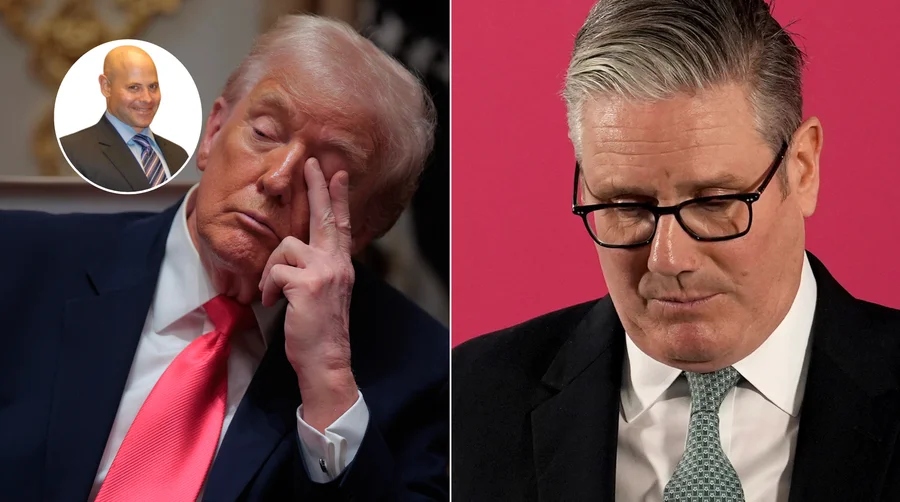
Keir Starmer just became Donald Trump’s new political piñata after £8bn surrender to the EU – Lee Cohen

By now, the pattern is painfully familiar. Whenever Labour Britain has a chance to act like a sovereign nation again, Westminster’s progressive class rushes to kneel before Brussels.
This week’s offering is Keir Starmer’s decision to drag Britain back into the EU’s Erasmus+ scheme — a project you deliberately walked away from after Brexit because it was poor value, structurally biased against you, and soaked in Eurocratic ideology.
Starmer presents this as a harmless “educational opportunity”. In reality, it is the reopening of a very expensive wound.
Britain will begin by paying hundreds of millions of pounds a year to rejoin a scheme in which she was historically a net loser, with critics warning that the long-term exposure could run into many billions over the programme’s life as temporary discounts expire and participation ramps up.
Call it what it is: a slow-burn financial recommitment to the EU, smuggled back in under the sentimental language of “youth exchange.
Donald Trump, the man who built a presidency on rejecting bad international deals, will look at this and shake his head in disbelief.
Trump understood something that Starmer plainly does not: great nations do not write blank cheques to supranational bodies that answer to nobody and prioritise everyone else’s interests first. During Trump’s presidency, America finally stopped apologising for itself.
The Paris Climate Accord — a moral vanity project that asked U.S. taxpayers to bankroll green schemes while China expanded coal production — was ditched.
The Iran nuclear deal, which funnelled cash to Tehran in exchange for temporary and unverifiable restraints, was torn up. The Trans-Pacific Partnership, a sprawling corporate-bureaucratic monster that hollowed out domestic industry, was scrapped. Even NAFTA was hauled back to the table and rewritten as USMCA, on American terms.
The principle was brutally simple: if a deal doesn’t benefit your country, you walk away.
Now look at Starmer’s Britain, where walking away is treated as vulgar, and submission is rebranded as sophistication.
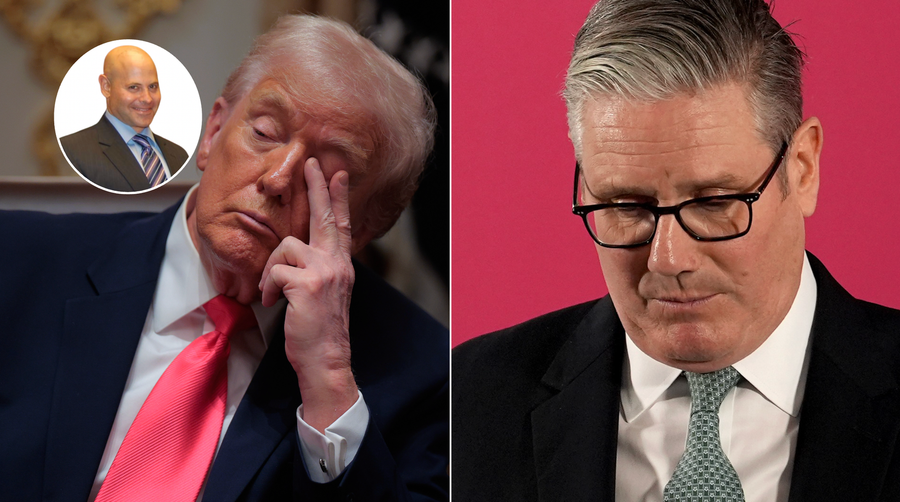
Keir Starmer just become Donald Trump’s new political piñata after £8bn surrender to the EU – Lee Cohen
| Getty Images
Erasmus was never a fair exchange for the UK. Before Brexit, British universities hosted far more Erasmus students than they sent abroad, meaning UK taxpayers subsidised European mobility while receiving limited reciprocal benefit.
Your campuses became convenient, taxpayer-funded pit stops for continental students, while participation by British students — particularly those from working-class backgrounds — lagged behind. That imbalance was openly acknowledged at the time, and nothing fundamental about the scheme has changed.
Instead of fixing this, Britain replaced Erasmus with the Turing Scheme — a genuinely global programme that sent British students not just to Europe, but to the United States, Canada, Australia, and beyond. It expanded destinations, widened access, and cut out Brussels entirely. No ideological strings. No structural disadvantage. No automatic financial asymmetry.
Starmer is now binning that in favour of a system designed by and for the European Commission.
Supporters insist the cost is “discounted” at first. That’s the trick. New entrants always get a temporary sweetener. But as participation rises and rebates fall away, Britain is once again exposed to escalating annual payments — all while surrendering control over programme design, funding priorities, and eligibility criteria. Any talk of reform, caps, or rebalancing has been quietly dropped.
There was no hard-nosed renegotiation, no demand for reciprocity, no insistence that Britain get more out than it puts in. Just a signature and a smile.
This is not education policy. It is Brexit reversal by instalment.
And yes, the same Remainer establishment that screamed about Brexit being “isolationist” is now giddy with excitement about re-entering an EU programme that explicitly binds Britain back into Brussels’ regulatory and funding orbit. Priti Patel is right to call it “undoing Brexit by stealth”.
Seventeen point four million people voted to leave precisely this ecosystem — the slow bleed of money, control, and accountability into European institutions that British voters cannot remove or reform.
Where is the accountability now? In Trump’s America, bad deals are challenged, renegotiated, or shredded — and voters knew exactly who to blame or reward.
In Starmer’s Britain, decisions with multibillion-pound implications are waved through under the cover of virtue-signalling press releases, amplified by a BBC that still treats anything EU-branded as morally superior.
Polls may show abstract support among graduates and metropolitan elites, but it will not be the chattering classes paying the bill. It will be ordinary taxpayers — the same ones told there is no money for border enforcement, policing, or fixing an NHS that is visibly cracking.
The European Commission will be delighted. Labour has spared it the embarrassment of having to negotiate. A “discount” today, a ballooning commitment tomorrow, and not a shred of leverage retained by Britain.
If Trump teaches anything, it is that this is exactly how bad deals are designed — front-loaded charm, back-loaded costs, and no exit without pain.
This isn’t really about students. It’s about instinct. Trump’s instinct was to defend sovereignty, demand value, and walk away when the numbers didn’t add up. Starmer’s instinct is to appease Brussels, flatter the BBC’s pro-EU choir, and reassure the same elites who never accepted the referendum result in the first place.
Were anyone else but Labour in power, one hopes some of that deal-making clarity would make it across the Atlantic. Until then, Erasmus is back — and with it, another quiet reminder that while bad deals get shredded in the United States, they get signed with a flourish in modern Britain.
One programme at a time. One concession at a time. One step closer back to Brussels — paid for, as ever, by everyone who voted to leave.