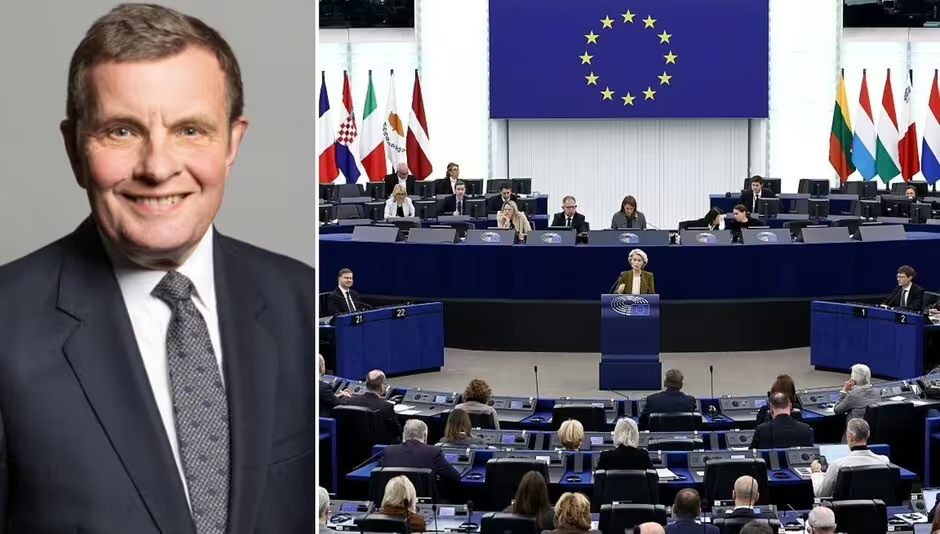

The Tobacco and Vapes Bill, now passing through the House of Lords, has exposed a deeply troubling constitutional problem: the United Kingdom can no longer be certain that legislation enacted at Westminster will apply uniformly across its own territory. Interventions from three EU member states have made that abundantly clear. Greece, Slovakia and Romania have formally objected to the Bill’s generational smoking ban. Their objections are grounded in the structure of EU Single Market law as it applies in Northern Ireland under the Windsor Framework.
The EU’s Tobacco Products Directive sets out harmonised rules on the marketing of tobacco. Member states may set their own minimum legal age of purchase, but are constrained by the Directive. Legal advice given to governments in Ireland and Denmark concluded that a generation-based prohibition would distort the Single Market and breach the free-movement principles of the EU Treaties. Both countries therefore abandoned plans for similar bans. The three objecting states have now said the same applies to Northern Ireland.
When he announced the Windsor Framework, Rishi Sunak claimed it would “deliver smooth-flowing trade within the whole United Kingdom, protect Northern Ireland’s place in our Union and safeguard sovereignty.” He said it would “remove any sense of a border in the Irish Sea.”
However, Northern Ireland remains bound to large parts of the EU Single Market for goods. EU law still applies there. The European Court of Justice remains the final arbiter. And when the United Kingdom proposes legislation that affects goods in Northern Ireland, it must submit to EU procedures before it can take effect. While that process runs, the UK may not bring the legislation into force in that part of the country.
That is what has happened here. The Government notified the Bill to Brussels in August, triggering an automatic pause on its application in Northern Ireland. The objections from the three EU states have now extended that pause until at least February 2026. Even after that date, the ban cannot apply in Northern Ireland unless the European Commission is satisfied that it complies with EU law.
That should trouble even those who support the smoking ban. Parliament may legislate for the whole of the United Kingdom, but the operation of that legislation in Northern Ireland depends entirely on the approval of a foreign authority. The Windsor Framework has been shown to be incompatible with Parliamentary sovereignty.
Furthermore, the policy cannot operate in practice. If the Government presses ahead with the legislation, the ban will apply in Great Britain but not in Northern Ireland. The enforcement gap will be immediate and obvious. A young person prohibited from buying cigarettes in mainland Britain could travel to Belfast, purchase them lawfully and bring them home without breaching any rule. The new law would thus be easily bypassed.
A measure that collapses on contact with reality is a futile absurdity. It invites evasion, undermines respect for the statute book and places enforcement authorities in an impossible position. It creates a two-tier United Kingdom, with contradictory legal regimes on either side of the Irish Sea.
The Government therefore faces an unavoidable choice. It can push ahead with a measure that cannot be enforced consistently, or it can withdraw it. The responsible course is to pull the Bill. The aim of reducing smoking is widely supported, but no government should ever enact a law that it knows cannot function as intended.
There is also a wider point that must now be faced. The Windsor Framework was presented as an elegant solution to a difficult problem. It was nothing of the sort. It preserved the central defect of the Northern Ireland Protocol. It left part of the United Kingdom subject to a foreign regulatory system and the jurisdiction of a foreign court. It ensured that any UK-wide legislation touching goods would remain vulnerable to intervention from Brussels.
The Tobacco and Vapes Bill has thrown that into stark relief. It shows that Parliament is no longer able to make coherent, UK-wide laws. That situation cannot be allowed to continue. A future government that takes British sovereignty seriously will have to revisit the Framework and restore the equal application of UK law throughout the entire nation.