

A new report recommends Sadiq Khan should not have control over the Met (Image: Getty )
Sir Sadiq Khan should have his powers to oversee the Metropolitan Police stripped according to a new report, which shows plummeting public confidence in the force since he was elected London Mayor. A damning study from the Policy Exchange think think tank records just 45% of Londoners believe the Met is performing well in their local area, down from 69% in 2016 when Sir Sadiq took office.
The scathing report, led by a former Scotland Yard detective chief inspector, found the Met only solved 1 in 20 reported robberies and burglaries, 1 in 76 reported bicycle thefts, 1 in 179 theft person offences and 1 in 13 shoplifting offences over the past year. Poor handling of large-scale protests which have brought much of the capital to a standstill in recent years, as well as weak neighbourhood policing, were also cited as reasons for the huge fall in public confidence.
A key takeaway from the research was a recommendation the Home Secretary should replace Sir Sadiq, and subsequent London Mayors, as the figure responsible for oversight of policing in the capital “given the very poor performance of the Metropolitan Police across a wide range of areas for an extended period”.
“Shifting direct political oversight to the Home Secretary … will enable both Government and Parliament to exercise far greater scrutiny and influence over the force’s performance in a way which has the potential to deliver the significant improvements required,” it said.

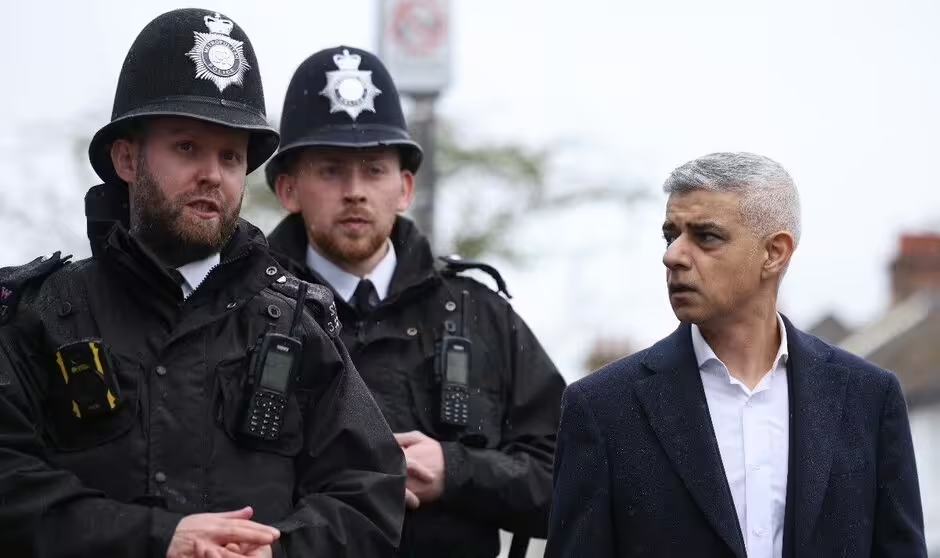
Sadiq Khan outside New Scotland Yard (Image: Getty )
The capital’s knife crime crisis was also laid bare, with the number of offences involving a blade 17.8% higher than in the West Midlands, 36.8% higher than Greater Manchester, 44.6% higher than South Yorkshire and 46.9% higher than West Yorkshire. This is significant as these are all major metropolitan hubs home to the UK’s biggest cities.
The Met’s approach to protests has also severely dented confidence, Policy Exchange said, with too much of the focus on the rights of protesters over protecting the public and growing fears over “two-tier policing”.
Shadow Home Secretary Chris Philp said: “There is still much to be done on the fight against crime in London – particularly knife crime and street theft – where rates of offending are far higher than other cities.
“Only a zero-tolerance approach to this sort of criminality, and the criminals responsible, will do.
“The force must continue to increase its use of facial recognition technology – an area which it should be commended for having pushed forward over recent years.
“Contrary to the apparent instincts of the Mayor of London, the force must keep using powers such as stop and search which is proven to reduce violent crime on our streets.
“Political leaders must back the police when they strongly enforce the law. Too often police officers feel stymied by an over-zealous oversight regime which has led to a sense of withdrawal from the streets by the police – something which benefits only the criminals who make life a misery for the law-abiding majority of people in our capital city.”
Tory MP Nick Timothy added: “The force has simply been too slow to make the necessary changes and too timid in its approach to crime and criminals.
“Of grave concern, and as clearly shown here, the way the Met has policed protests – particularly since the October 7th terrorist attacks – has demonstrated that ‘two-tier policing’ has become embedded in our police forces.
“The Government must take seriously the report’s recommendations – particularly those relevant to the ineffective oversight of the force by the Mayor of London. The safety of those who live, work and visit the capital are dependent on ministers taking this situation more seriously.”

Sadiq Khan and Sir Mark Rowley (Image: Getty )
Report author David Spencer said police chiefs have failed “to prioritise the rights of ordinary members of the public” as protesters marched through London.
And Mr Spencer dismissed claims many of the demonstrations were peaceful. He wrote: “The sense that many of the recent wave of protests have been “peaceful” by any ordinary understanding of the word – particularly when filled with antisemitic chanting through mobile sound amplifiers, calls for “jihad” on the streets of London, or the use of criminal damage as a tactic – is clearly false.
“Despite the denials, it has become increasing evident that “two-tier policing” is a reality.”
Drawing on the example of police restrictions on a UKIP march in Tower Hamlets, Mr Spencer: “However, the willingness of the police to impose such stringent restrictions to safeguard the local Muslim population, while apparently being unwilling to go similarly far on behalf of the Jewish community or the broader public at previous events, indicates a readiness among senior officers to apply different standards to different groups.
“If the rationale for the force’s decision is because they feared public disorder from those resisting the protest than from the protestors themselves) it is tantamount to an admission that “mob-rule” has taken priority over the rule of law – an unacceptable state of affairs.”
Mr Spencer said the force’s handling of protest is “inadequate”.