
The Labour government is set to introduce four more council tax bands from April 2028. The charge, which will be added to the usual council tax bills, will be applied to property owners rather than tenants.
The Government has confirmed that homes worth over £2 million will be hit by a high-value council tax surcharge. The new council tax bands will start at £ 2,500 a year for homes worth over £2 million. This figure will rise to £7,500 for properties worth more than £5 million.
On the changes, the Valuation Office Agency said: “The government has announced that, from April 2028, it plans to introduce a new High Value Council Tax Surcharge (HVCTS) on owners of residential property in England worth £2 million or more.”
It continued: “The surcharge will not be determined by current Council Tax bands, which are based on property values from 1991. For example, bands F, G and H will not be used to determine eligibility for the surcharge.
“The Valuation Office Agency will carry out a separate, targeted valuation exercise to determine a property’s value in 2026. If a property is identified as being worth £2 million or more, it will then be placed into one of four HVCTS bands.”
The agency continued: “This exercise is separate from, and without reference to, existing council tax bands. Council tax bands will not be used to determine eligibility for the surcharge and will have no bearing on a property’s HVCTS band.
“As this charge is separate from council tax, current council tax bands will not be affected and will still apply. Equally, a change in Council Tax band will not affect eligibility for the surcharge.”

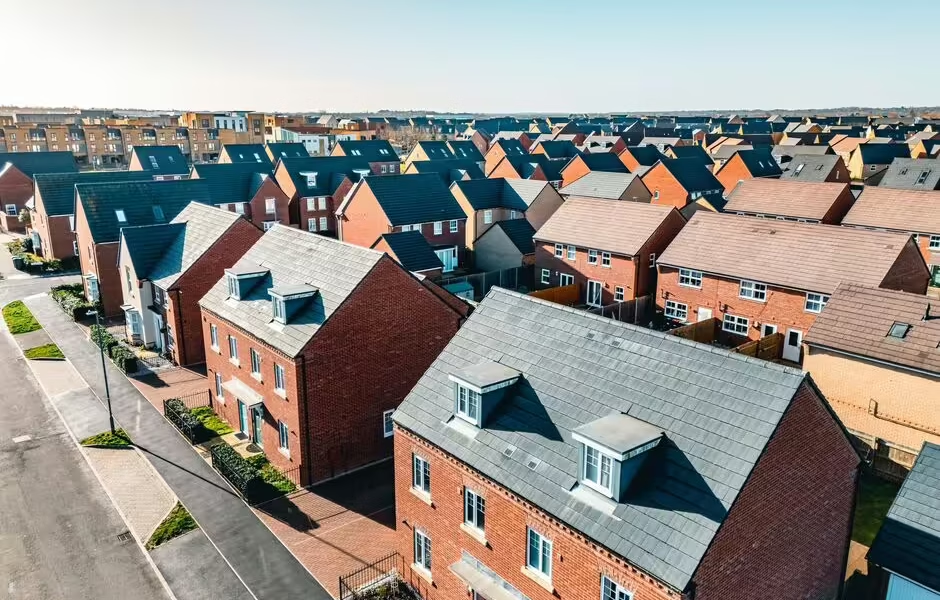
Homes over £2m will be impacted (Image: Getty)
According to Birmingham Live, HMRC recently reported that approximately 98,450 home sales occurred in October 2025. This figure is 2% lower than it was a year ago but 2% higher than in September 2025.
Nick Leeming, chairman of estate agency Jackson-Stops, said: “Today’s transaction results show a mixed-bag; whilst there were reports of transactions pressing ahead to beat the Budget deadline, in the main we saw a market on pause.”
He added: “It is likely we will see more stock come to the market in the short-term, with minor price adjustments for properties just over the £2 million cliff edge. We might also see an increase in demand for homes under the tax limit, where buyers adjust budgets with household cashflow in mind.
“For the South East, this could create upward pressure on prices in the mid-tier or even lower-end property markets, leading to spillover effects for demand in new areas.
“Jackson-Stops’ national figures show a more selective market overall, but it’s far from a one-size-fits-all story. Outside the South East, the £500,000 to £800,000 bracket is bucking the trend, with momentum gathering pace – proof that some regions are very much putting their foot back on the gas.

Homes worth over £5m will be in the £7,500 bracket (Image: Getty)
“We have heard from agents across the country following the Budget that prime buyers are moving at pace with clarity now in mind.”
A spokesperson from north London-based estate agency Jeremy Leaf said: “As affordability gradually improves, especially with another base rate cut looking likely, we expect transaction numbers to pick up.
“With the Budget out of the way, and mansion tax likely to raise relatively little additional revenue, especially given the deferred payment date, the impact on housing market activity should be minimal at worst.”
Meanwhile, Sarah Coles, head of personal finance at Hargreaves Lansdown, explained: “The data reflects sales agreed months earlier, before the Budget rumour mill had fully cranked into action.”
She added: “The fact that the Budget didn’t deliver a major blow for buyers should help support sales in the coming months. News of the so-called mansion tax, with an annual charge on properties worth more than £2 million, may well make a difference at the top end of the market, and some of that will trickle down. However, it’s nowhere near the kind of impact that a wide-ranging and expensive tax could have had.”