
If the Prime Minister thinks Britain can fight wars on multiple fronts he really is as deluded as we all think, writes Giles Sheldrick.

Sir Keir has shown he is out of his depth when speaking about the UK’s military capabilities says Giles Sheldrick (Image: PA)
Sir Keir Starmer’s approach to defence should terrify us all. Britain’s slump down the league table of militarily able countries is hastening under Labour.
And anyone who thinks we’re now capable of fighting a war, never mind embarking on conscription to cobble together a willing and able force, has another think coming. Rather like the Army, Navy, and RAF, the UK under this government has become a shadow of what it once was.
If we cast our minds back only six weeks ago Rachel Reeves congratulated herself on her Budget. It was one that saw the two-child benefit cap axed in a move that increased handouts to 560,000 families by an average of £5,310. And spending on welfare is set to rise from £333 billion a year to £389.4 billion in 2029/30.
Now the dust is settling it is clear it was a benefits bonanza with the work shy and feckless – Labour’s base – firmly in mind.
But with the world tipped on its head and threats – both malevolently covert and overt – becoming ever greater Britain’s lackadaisical approach to defence is coming home to roost.
The number of Armed Forces personnel has decreased by one fifth, from around 186,000 in 2012.
Labour would rather lavish cash on the lazy than fund then money to bolster troop numbers. And to think that some still seriously believe the call of duty would be answered if it came.
And that is why the prime minister’s latest pathetic pronouncement on defence isn’t worth the paper it is written on.
He now says he is considering sending British troops to Greenland in response to US President Donald Trump ramping up his rhetoric over snatching back Danish territory.
Just days ago he committed to sending UK troops into Ukraine as part of the so-called Coalition of the Willing headed by his pal, pound shop Napoleon Emmanuel Macron.

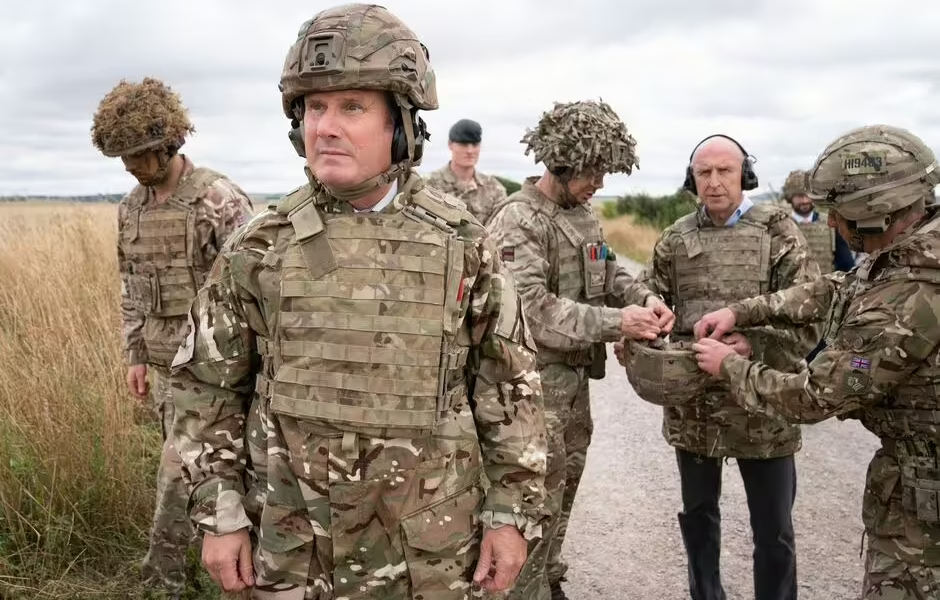
PM Sir Keir Starmer talks to UK troops (Image: POOL/AFP via Getty Images)
Successive Budgets have told us that numbers are not Labour’s forte.
So perhaps the PM needs reminding just how sparse our Armed Forces are at a time Britain faces threats from all points of the compass.
The brutal reality is we are simply not prepared to mount, or to respond, to a war. Let alone two. Or three.
The numbers serving have been whittled down to historically low numbers not seen since the mid-19th century – around two-thirds less than the standing troop numbers before the First or Second World Wars.
At the time of the Falklands War in 1982 numbers were closer to 350,000.
It will hurt many to accept but the British Army, Royal Navy and Royal Air Force are shadows of the fighting forces they once were.
Figures show our threadbare forces – including army regulars and reservists – now total a paltry 180,000 with for years the number of people joining the UK regular forces lower than the number leaving.
Successive military top brass warned of the danger and now the UK faces a £28 billion shortfall in defence funding.
In 2024 General Sir Patrick Sanders, the former Chief of the General Staff, said Britain must be prepared to mobilise tens of thousands should we find ourselves at war with rogue states.
Lo and behold China continues its campaign of malevolent infiltration while Russia sabre rattles off our coastline and on the edge of our airspace.
While Starmer presents to be a political colossus when the reality is he is a political pygmy blind to the danger and ignorant of the facts.
The reality is our severely depleted Armed Forces would barely be able to defend the country, let alone fight a war on multiple fronts.
The truth is Britain’s military was once the envy of the world. It is now barely able to cobble one together, let alone properly equip it.
Labour MPs urge Keir Starmer to clarify stance on non-cash slavery reparations.H
No 10 says issue is off the table for Commonwealth summit but other nations are prepared to defy UK
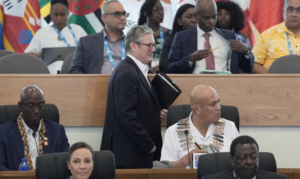
Keir Starmer attends an executive session of the Commonwealth heads of government meeting in Samoa on Friday. Photograph: Stefan Rousseau/Reuters
Labour MPs have urged Keir Starmer to clarify his government’s position on non-cash reparations for Britain’s historical role in the slave trade, as No 10 says the issue is off the table.
In the run-up to the Commonwealth heads of government meeting (Chogm), the government said it would not be issuing an official state apology.
While travelling to the conference, which began on Friday in the Pacific island nation of Samoa, the prime minister told reporters he wanted to “look forward” rather than have “very long endless discussions about reparations on the past”.
King Charles acknowledged “painful aspects” of Britain’s past but sidestepped calls to directly address reparations for slavery, saying: “None of us can change the past, but we can commit … to learning its lessons.”
Despite the insistence from Downing Street that the issue was not on the agenda for the summit of 56 Commonwealth countries, leaders were prepared to defy the UK. A draft version of the final communique that was leaked to the BBC this week said leaders had “agreed that the time has come for a meaningful, truthful and respectful conversation towards forging a common future based on equity”.
Amid mounting pressure, a source in No 10 said the UK could support some forms of reparatory justice, such as restructuring financial institutions and providing debt relief.
This was initially welcomed by the Labour MP Diane Abbott, who sits on the all-party parliamentary group for Afrikan reparations. She said she was “glad that Starmer seems to have backed off from his complete hostility to the concept of reparations. It remains to be seen what he means by ‘non-financial reparative justice’.”
Some campaigners were frustrated by what they felt was either a game of semantics on the issue or a deliberate misrepresentation of what the campaign for reparations is. Part of the long-established 10-point plan for reparatory justice by the Caribbean community (Caricom) is debt cancellation, while others have long campaigned on the link between reparatory justice and climate resilience.
Michael McEachrane, the UN rapporteur of the permanent forum on people of African descent, said: “Keir Starmer misrepresents reparations … It is a matter of taking responsibility for and transforming legacies of the past in the present.” Only then, McEachrane added, would the Commonwealth community see “greater equity within and among countries”.
When No 10 was pressed to explain what it meant by non-financial reparative justice in Friday’s press briefing, a spokesperson pushed back on the idea. The prime minister’s deputy spokesperson said: “Our position on reparations is clear, and that goes for other forms of non-financial reparatory justice too. The prime minister’s focus is on addressing the challenges that we face.”
In response, Abbott said: “Incredible that Starmer wants to treat the leaders of fellow Commonwealth countries with such disrespect. And it is offensive that he seems to be saying that he knows what they want to discuss better than they themselves do.”
Another Labour MP, Clive Lewis, questioned how Starmer and his team could have gone to the summit and not expected reparations to come up. “Has he not been paying attention to the African Union, Caricom, [the Barbados PM] Mia Mottley, the Bridgetown Initiative? This is what has been happening whilst he has been in politics,” he said.
“It looks very much like they’ve said, in a very kind of colonial mindset, that this is not for discussion. It’s not on the agenda. Well, that’s not going to go down well in a Commonwealth of equals.”
Lewis, who called in parliament for the UK to enter into negotiations with Caribbean leaders on paying reparations for Britain’s role in slavery, said: “You have to ask the question, given that David Lammy [the foreign secretary] himself is a son of Guyana, who has been talking about this for years, the person who came after Bernie Grant: someone lost a memo somewhere.
“I can’t believe that David didn’t know that this was going to come up, and someone must have told No 10 this was coming up … it is quite revealing of something.”
State pensioners urged to do £4,000 DWP check ahead of triple lock increase
An expert said rising bills are already impacting many state pensioners

The triple lock is expected to boost state pension payments by 4.8 percent next year (Image: Getty)
State pensioners have been urged to check over the finances. Claimants may want to plan ahead ahead of next year’s triple lock increase, which is on course to boost payments by 4.8 per cent. This would increase the full new state pension from the current £230.25 a week to £241.30 a week, or £12,547.60 a year.
But as state pensioners have to wait until next April for the pay increase to kick in, they face rising the winter months ahead first, with potentially higher energy bills. Mike Ambery, retirement savings director at Standard Life, warned that pensioners are “already feeling the pressure of rising costs” going into the colder months.
He said: “The cost of living remains high and state pensioners, unlike people of working age, usually don’t have the chance of an earnings boost through a pay rise or bonus.”
He shared some tips for pensioners to keep on top of their finances.
The expert said: “The key thing is to regularly review all income and outgoings, check eligibility for all extra support including state benefits and seek help as soon as possible if things seem overwhelming. Even small steps, like setting aside money for seasonal bills or reviewing direct debits and subscriptions, can make a difference.”
One means of support worth looking at is Pension Credit, a hugely underclaimed benefit. The DWP benefit is available to people of state pension age and tops up your income, with the average claim worth over £3,900 a year.
The benefit tops up your income to £227.10p a week for single claimants and up to £346.60p for couples. You may qualify for extra amounts depending on your situation, such as if you care for another adult.
With the costs of the state pension ever increasing, some experts fear it could soon become unaffordable. But Mr Ambery said Labour will probably commit to it in the Autumn Budget.
He said: “It’s highly likely that the Chancellor will confirm the triple lock in the Budget as the Government has consistently reiterated a commitment to maintaining it – and with the revived Pensions Commission set to review both state and private pensions over the next 18 months, any major changes to the triple lock mechanism seem unlikely in the short term. Alongside this, the ongoing state pension age review further signals that any changes to the state pension are being approached methodically, rather than through sudden shifts.”
Research from Standard Life found that only 51 per cent of people think the state pension will exist as a universal benefit by the time they retire, while just 29 per cent expect the triple lock to still be there when they stop working.