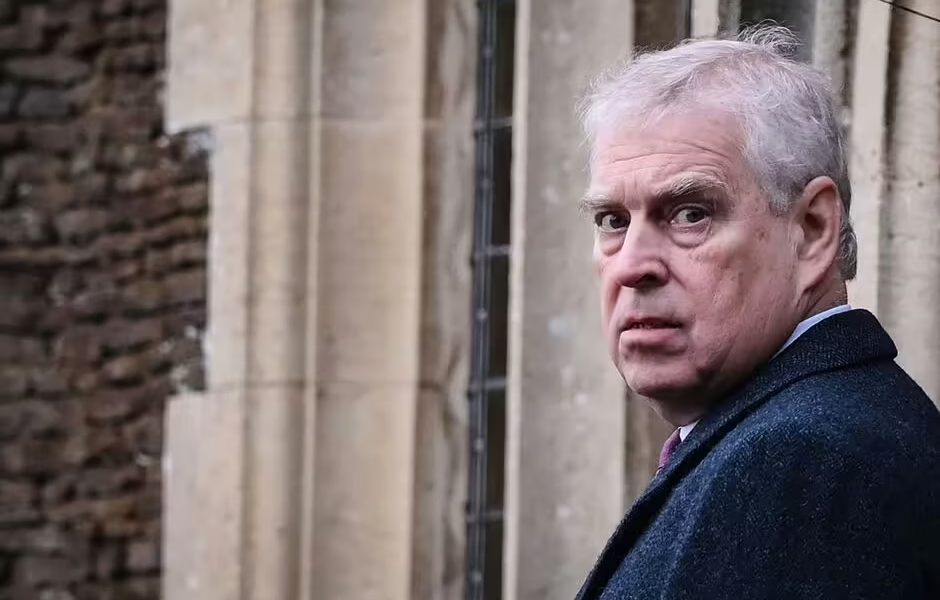

The Royal Family could have avoided the catastrophic publicity of the recent scandal involving Andrew Mountbatten Windsor’s relationship with sex abuser Jeffrey Epstein if they had been more nimble when the accusations first came to light, says David Dimbleby.
The veteran royal commentator, who fronts a new BBC documentary series, What Is The Monarchy For?, believes conflicted family loyalty lies at the heart of the problem.
“It’s been very difficult for Charles’s reign for various reasons,” he tells the Sunday Express. “The first difficulty is the conflict between the Royal Family as a real family with brothers and uncles, and the Royal Family as an institution, and the two are clearly in conflict with each other. It dragged on and on but I sort of understand it because it must be incredibly difficult to reconcile the institutional demands with family loyalties.”
In his new three-part series, Dimbleby, 87, examines how the monarchy works and delivers a fresh appraisal of an old institution since the coronation of King Charles III in May 2023.
But the question of Andrew, he feels, is a tale as old as time.
“Many families have problems, and difficult relations but they handle it privately. But to have to handle a thing like this in public when actually you have to decide between what you might do as a family and what you feel you have to do as an institution is very difficult and takes time to resolve.”
He continues: “The Queen’s instinct seems to have been to protect Andrew so it took 14 years after the allegations about Virginia Giuffre came out for him to be finally stripped of his titles and turn him back into a citizen and not a prince.
“That long process was damaging because it just drew more attention to the issue than, say, if in year one or two, he had given up everything. But it didn’t go like that.
“He first of all said he wouldn’t be using his titles and then it moved on with the Queen stripping him of his regimental duties, then the charities kicked him out but he still remained. He remained a Knight of the Garter for instance.
“The Queen still took him as her escort to the Duke of Edinburgh’s memorial service and it took until two months ago, as far as the public was concerned, to turn him back into a civilian with none of the privileges of monarchy.”
Could Andrew’s punishments have gone further as some critics have suggested or have they gone far enough?
“What, execute him?” Dimbleby replies wryly. “No they shouldn’t. I don’t know what he will do. He has returned to civilian life and I assume the wealth of the Royal Family will protect him. He is a rich man.
“But in terms of the removal from public life, that has been completed. People know the King was not implicated in what Andrew got up to but he was given too much of a loose rein. It was absurd the way he behaved when he was so called trade ambassador. Whoever invented that idea needs their brains tested.
“There were constant complaints about him from real ambassadors that he was rude and didn’t do anything. ‘Airmiles Andy’ flying around to golf courses. What did he know about trade? It was ridiculous.”
Yet he believes that Andrew’s two daughters Princess Beatrice and Princess Eugenie, who have retained their royal titles, should be allowed to carry on as working royals.

Legendary broadcaster David Dimbleby fronts new series What’s The Monarchy For? starting Tuesday at 9pm on BBC One. (Image: BBC)
“They’re not besmirched by the scandal of Giuffre,” he shrugs. “I would imagine that having more hands to the pump to carry out the range of royal duties would be quite valuable. [Princess] Anne does a lot of the workload.”
Nonetheless, Dimbleby thinks that recent events have been the biggest scandal to rock the institution for 70 years. He compares the fallout to when Princess Margaret was forced to choose between royal duty and the man she wanted to marry, divorced royal equerry Peter Townsend in 1955. She eventually broke off the engagement.
“I can’t think of any scandal in my lifetime on the scale of Andrew,” Dimbleby continues. “Harry and Meghan are different. They scarpered and good luck to them. No reason to stay. It’s not an easy life being in the Royal Family.
“They seem very happy. Andrew’s a big one really. Because they tried to protect him. They didn’t do a clean-cut thing. But will it shape the future of the monarchy? I don’t think these dramas are insuperable. People are quite forgiving about particular difficult moments.
“They don’t expect the Royal Family to be a perfect family. They’ve seen enough, going way back with Edward VIII, and Margaret, and problems with Diana, Anne’s divorce, Meghan. I don’t think for instance the King or William will be affected by Andrew.
“It obviously doesn’t enhance the standing of the Royal Family but equally I don’t think it’s destructive either.”
Today he predicts that the Prince of Wales will want to shake up the institution when he ascends the throne.
“The monarchy needs to evolve and the evolution is in William’s hands,” he says.
“The King is there now and doing it the way he wants to do it. Considering he’s ill, I think he’s extraordinary. But William has said, ‘Change is on my agenda’. So he does want to change. How, we don’t know. I don’t think he’ll publish a manifesto: ‘This is the kind of King I’m going to be…’,” he smiles. “I think we’ll gradually see a difference.”
In his new series, Dimbleby explores the monarchy’s power, wealth and image – “they all tie in together really” – and asks how the institution may evolve talking both with insiders andt the public young and old.
He suggested the idea to the BBC two years ago, after the late Queen’s death.
“We had a new regime, a new King and a new Prince of Wales and I thought it was a good moment to take stock of the monarchy itself, how it stood in public estimation and issues we needed to look at for the 21st century but never really looked at,” he explains.
“We cover ceremonials and occasionally we do interviews like with [Princess] Diana and Martin [Bashir] or Andrew with Emily Maitlis but the actual structure of the monarchy and the way it works, and the privileges it has, and all of that, and the way it operates, has never been explored.”
Filming started in spring 2024 but stopped for several months when the King got ill before picking up in October last year. Dimbleby calls it “a long process and a lot of interviews”.

The late Virginia Giuffre, with a photo of herself as a teen. (Image: TNS)
He continues: “It was the late Queen herself who said back in 1992, ‘No institution – City, Monarchy, whatever – should expect to be free from the scrutiny of those who give it their loyalty and support, not to mention those who don’t’. I have often thought about that comment and it’s a challenge I took up.”
As for whether the Royal Family provides value for money, it’s hard to quantify.
“They’re very expensive,” he admits. “But only today I was thinking of the alternative, which is an elected President, and I think it would be incredibly difficult, actually.
“To get one to represent Scotland, England, Wales and Northern Ireland in a satisfactory way would be almost impossible. So in terms of keeping the United Kingdom together, I suspect a constitutional monarchy is probably the best way.
“But one that is in tune with the spirit of the times and it sees people becoming disaffected, and not liking the pomp and circumstance too much, and thinking it’s overblown or too rich, or too privileged, and shouldn’t be an exemption from tax of all kinds, and laws.
“But the role certainly fulfils a constitutional function. We look at that in the films because in my mind there is a big question mark over whether the constitutional role was fulfilled when the Queen granted Boris Johnson that proroguing in 2019 which then turned out, according to The Supreme Court, to be unlawful.
“That’s a conundrum I haven’t got my head round.”
So what is his conclusion to the question of What Is the Monarchy For?
He pauses. “That you have to have a head of state. And that’s what the monarchy is for but it has to be sensitive to the public.”
Dimbleby’s opinions matter. He has been a tour de force in BBC television for over 60 years, as a presenter of current affairs programmes and documentaries, and as a commentator. More recently, he commentated on the state funeral of Queen Elizabeth II for the BBC and for 30 years he has been synonymous with Remembrance Sunday events at the Cenotaph.
He was notable by his absence this month. Admitting he has stepped down from the role, he explains: “If you do the same thing for a long time there is a danger it becomes a ritual and you lose your edge.”
These days he divides his time between a farm in Polegate, East Sussex, and a home in Pimlico, London, where he lives with his second wife Belinda Giles, a former TV producer, now a psychologist. They celebrated their 25th wedding anniversary this year.
“I bought some caviar and a bottle of vodka,” he smiles.
He has four children, three from his first marriage to cookery writer Josceline Gaskell, and a 27-year-old son Fred from his second marriage, who works as a journalist for ITV.
“And he’s bloody good at it,” he says emphatically with paternal pride. “He keeps me young… and my seven grandchildren. I love seeing them but I’m so busy.”
Indefatigable as ever, he’s visibly animated talking about a new podcast he’s making for Radio 4 about the rise and fall of American power.
“I should be concentrating on my drawing, sailing and walking but broadcasting always gets the better of me,” he smiles.
Last year, he lost his brother, sculptor Nicholas Dimbleby to motor neurone disease, and he alludes to a recent period of his own ill health, saying vaguely: “I had a bad half year but I’m better.”
He works out daily for 20 minutes but hates it. “I do weights and I’m on a bike machine. You have to at my age. I play tennis and my great love is sailing. I’ve had a boat for 45 years.”
He agrees it is pleasing to still be visible on television after a certain age, and laughs saying: “David Attenborough is one I need to follow. He’s 100 soon so that gives me another 13 years of work. Every day I wake up thinking, ‘Why can’t this go on forever?’”
- What’s The Monarchy For? starts Tuesday at 9pm on BBC One

What’s The Monarchy For? starts Tuesday at 9pm on BBC One (Image: CREDIT LINE:BBC/The Garden TV)