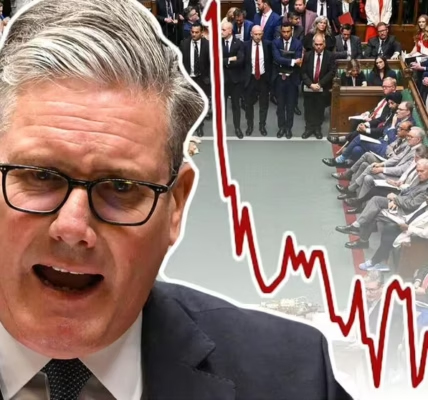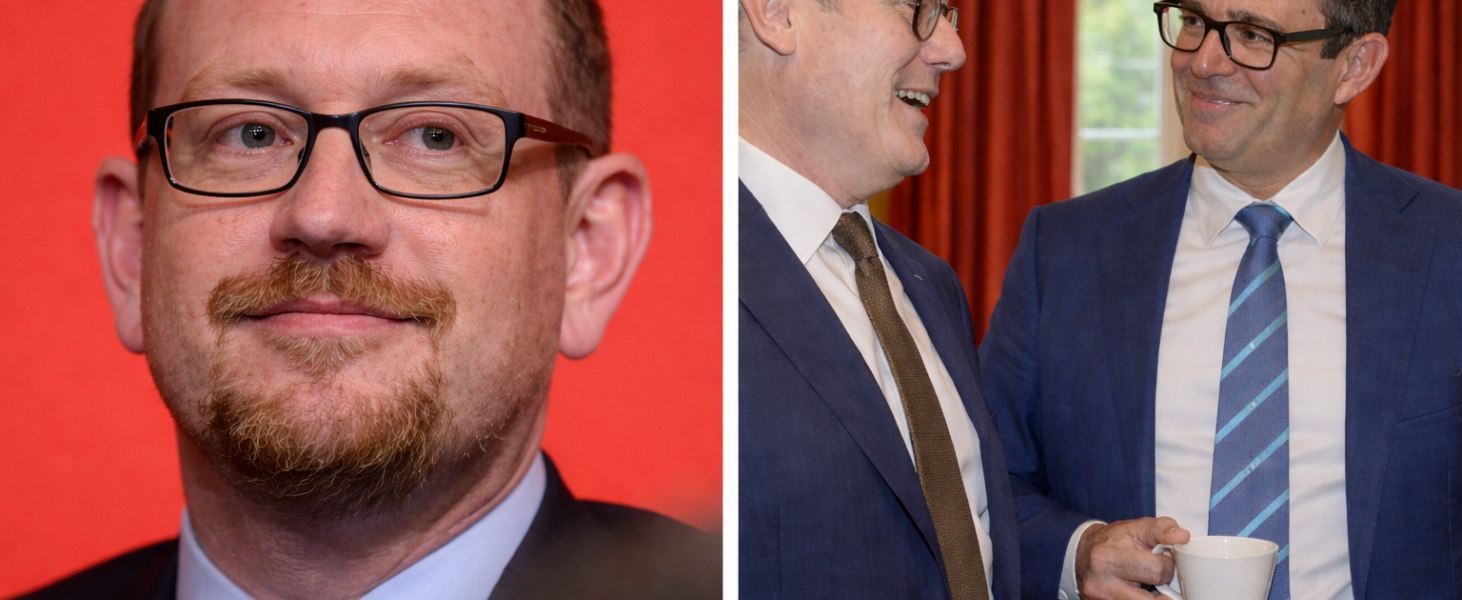

Summary: Reports claim Andy Burnham has lined up a Westminster return via a May by-election, fuelling fresh talk of Labour infighting and a leadership challenge. Labour figures deny any “sewn up” plan, but the story underlines how fragile Keir Starmer’s authority looks inside his own party.
Claims of a “secret deal” to bring Andy Burnham back to Westminster
Fresh Westminster briefing suggests Greater Manchester Mayor Andy Burnham is considering a return to Parliament, with claims he could run as an MP in a by-election timed for local election day in May.
The report alleges that a Labour seat could be cleared to make way for him, potentially setting up a high-profile contest that would instantly sharpen internal pressure on Sir Keir Starmer.
According to the account, Labour MPs were told in the Commons tearoom that a plan was already “sewn up”, with a sitting MP stepping down in March and Burnham running in May.
“He was boasting in the tearoom saying that a deal has all been sewn up… Gwynne is stepping down in March and Andy will run in May.”
Andrew Gwynne standing down rumours and Labour’s messy internal politics
The reported route back would depend on Andrew Gwynne leaving his seat, triggering a by-election. Gwynne now sits as an Independent after being removed from Labour following a WhatsApp controversy.
However, Gwynne has publicly pushed back on the specific claim about a March announcement, pouring cold water on the idea that any timetable is locked in.
“I won’t be announcing any such thing in March.”
Why this matters for Starmer and what it says about Labour’s direction
Even if the details prove overstated, the political significance is obvious: Labour looks like it is briefing against itself again, with factions treating the Prime Minister’s position as negotiable.
That is bad news for a government that needs discipline to deliver. Instead, Labour risks turning Westminster into a permanent leadership soap opera, just as voters want competence and clarity.
For Brexit Britain, this matters because Labour’s internal war is often fought by reaching for “reset” language with Brussels, soft-alignment signals, and policy ambiguity.
Voters who backed sovereignty and stronger borders will see the same old pattern: Labour figures posturing for power, while the national interest gets treated like a bargaining chip.
Reform UK pressure and the reality Labour is trying to dodge
The wider backdrop is the growth of Reform UK and Nigel Farage’s ability to weaponise Labour’s indecision on borders, the economy, and national sovereignty.
Labour MPs know that if they look weak or divided, Reform’s pitch gets easier: smaller government, tougher borders, and less deference to international courts.
That is especially relevant as public frustration grows with the UK’s ability to control migration and remove foreign offenders, where ECHR-linked legal barriers are routinely cited as a constraint.
Whether or not Burnham is plotting, the fact these rumours land so easily tells you what many in Labour already fear: Starmer is not commanding loyalty, and the public mood is shifting.
What has been confirmed and what has not
At this stage, the key claims remain based on anonymous briefings and reported conversations rather than official announcements.
Burnham has declined to comment, while Jim McMahon has not responded to requests for comment, and Gwynne disputes the timeline attributed to him.
Lord Frost: Starmer’s “Brexit Betrayal Bill” Leaves Britain With “No Say” in Brussels Rules

Summary: Lord David Frost has warned that Labour’s planned EU “reset” Bill risks pulling Britain back under Brussels rule-making without a vote for MPs or the public, arguing it would leave the UK “subject to what Brussels decides” while having “no say” over the rules.
Lord Frost: “We will get no say”
Lord David Frost, the former Chief Negotiator for Exiting the European Union under Boris Johnson, has launched a fresh attack on Labour’s approach to post-Brexit relations with the EU.
Speaking to Camilla Tominey on GB News, Frost argued that Labour’s planned legislation would amount to a quiet transfer of control back towards Brussels, without the public being asked.
“It’s going to make us subject to what Brussels decides to do in this area, and we will get no say.”
Frost’s warning comes amid reports that the Government is preparing a wide-ranging “reset” Bill designed to underpin closer cooperation with the EU across multiple sectors.
What Labour’s EU “reset” Bill is expected to do
According to reporting on the planned Bill, ministers would be given powers to implement and update alignment mechanisms linked to new UK-EU arrangements, particularly in areas such as agrifoods and electricity trading.
Critics say the concern is not just what is written on day one, but the scope for future “dynamic” alignment that keeps pace with new EU rules, even when the UK has no vote in making them.
The reported policy areas in play include food standards and animal welfare, the electricity market, and carbon-related trading and costs.
A UK official cited in the reporting said a draft could be presented to Parliament in the spring or summer of 2026.
Frost’s core claim: Labour’s “repair” argument collapses into EU rule-taking
Frost said Labour’s approach stems from the belief that Brexit and the Trade and Cooperation Agreement caused economic damage that must be “repaired” by a new deal.
In his view, that logic leads to only one destination: re-entering EU legal frameworks sector by sector.
“Their only option is to go back into the EU’s legal framework for things like food, carbon costs, energy, electricity costs.”
He said that would “deprive us of the ability to set our own rules for our own interests, in our own country”, framing the row as a sovereignty question rather than a technical trade fix.
“Drifting back… bit by bit”: the single market warning
Frost also attacked Labour’s repeated insistence it will not take the UK back into the EU’s single market or customs union.
He argued that the single market can be entered in parts, and that sector-by-sector alignment is effectively that process in slow motion.
“The single market isn’t a thing that you are kind of a complete member of or not. You can be in bits of the single market… We are drifting back into the single market bit by bit.”
This is the political pressure point for Labour: closer ties may be sold as practical “barrier-busting”, but opponents brand it as rule-taking without representation.
Liberal Democrats push customs union vote as Labour faces pressure
The argument is also being inflamed by renewed pressure from committed Remainers in Parliament.
The Liberal Democrats have proposed a 10 Minute Rule Bill aimed at rejoining the EU’s customs union, and the move has been reported as attracting support from more than a dozen Labour MPs.
In the GB News exchange, Tominey put the broader point bluntly.
“Do you accept that these Remainers are never going to let this go?”
Frost agreed there is a “hard core remain establishment” that wants the UK back in the EU, and claimed it is taking “every step” to shift the country in that direction.
Why this matters: accountability, Parliament, and control
At the heart of the row is not a single clause but a wider fear about how major constitutional and economic decisions are made.
If the Government asks Parliament to grant broad powers before final UK-EU deals are settled, opponents argue MPs would be voting on a blank cheque.
Supporters of closer alignment argue it is a rational way to reduce friction in trade and cooperation. Critics argue it re-runs the pre-Brexit problem: rules set elsewhere, enforced through external mechanisms, with Britain locked into compliance.
As the Bill moves towards publication, the fight is likely to centre on one simple question: who makes the rules, and who can change them.
Britain Faces Power Rationing Risk as Ageing Gas Plants Near Shutdown

Summary: A new report has warned the UK could face a rising risk of winter electricity rationing before the next general election unless ageing gas power stations are upgraded or replaced, with planned nuclear closures and slow-to-build new capacity adding to system pressure.
Report warns of rising rationing risk
An energy consultancy report has warned Britain could face electricity rationing within the next five years if urgent steps are not taken to shore up “dispatchable” power generation and reinforce the gas network.
The report, produced by Watt-Logic, says a significant share of the UK’s gas-fired power station fleet is reaching the end of its workable life, with key replacement parts taking years to source and install.
“Without urgent action to secure dispatchable generation and stabilise the gas network, the UK faces escalating risks of supply shortfalls and widespread system failures well before 2030.”
Watt-Logic added that meeting demand could become harder as electricity use increases through wider electrification of transport and heating.
“It will be difficult to meet existing demand without rationing, let alone any additional demand from electrification.”
Why gas still matters on low-wind days
Gas-fired plants currently generate around a third of the UK’s electricity, but their importance can rise sharply during periods of low wind when renewable output drops.
The report argues that losing multiple gas units without enough replacement capacity would increase the risk of shortfalls, particularly during winter peaks.
Kathryn Porter of Watt-Logic said many stations were built in the 1990s and, while some were upgraded later, critical components may not have been replaced.
She said that “while most received upgrades in the 2000s, in most cases this did not involve replacing rotors”.
On the consultancy’s assessment, the risk of rationing rises over the next five years and could peak between 2028 and 2031 as older units drop out.
Nuclear closures and slow replacement pipeline
The report says the challenge could be compounded by the planned shutdown of ageing nuclear stations, with most of the remaining reactors expected to close before or in 2030.
It notes that some new power stations are in planning or construction, including gas-fired projects, but argues the current pipeline would not fully offset likely losses if multiple older stations retire early.
The warning lands amid a wider debate over security of supply, the pace of decarbonisation, and the balance between renewables, gas, and firm capacity.
Scotland flagged as a particular vulnerability
Watt-Logic also raised concerns about resilience in Scotland, warning the grid there relies on a small number of power stations capable of maintaining system stability.
Ms Porter warned Scotland has just two power stations she described as capable of keeping power flowing through the grid, and both were said to be at risk of failure.
Which plants are named in the report
The report cited more than a dozen gas-fired power stations as old enough that they may not last until the end of the decade, including sites operated by major generators.
It listed Medway, Saltend and Seabank (operated by SSE), plus Connah’s Quay and Cottam (run by Uniper), and Little Barford (run by RWE) among those highlighted.
Uniper said it was confident its power stations would continue operating, while other firms were approached for comment.
Government and system operator push back
The National Energy System Operator (Neso) responded by stressing confidence in the resilience of Great Britain’s grid as new renewable capacity connects.
“Great Britain has one of the most secure energy systems in the world… our engineers are confident Britain’s grid will continue to operate safely and securely as more renewables connect to the network in the years ahead.”
The Department for Energy Security and Net Zero said decarbonisation improves security over time, while acknowledging gas will remain part of the mix during the transition.
“The National Energy System Operator has been clear the faster we decarbonise, the more secure we are.”
“Gas will continue to play a key role in our energy system as we transition to clean, more secure, homegrown energy.”
The department added it is pursuing a major upgrade of Britain’s electricity network to support clean power goals into the next decade.
Political row over net zero and reliability
The report has immediately fed into the political battle over energy policy, with critics arguing the transition plan is exposing reliability risks unless firm capacity is secured in parallel.
Claire Coutinho, the shadow energy secretary, said the findings showed net zero policies risk damaging the economy and called for a change of approach.
“This report lays out in expert detail how Britain’s net zero plans are taking us down a path of economic ruin. If ministers were truly interested in making Britain rich again, they would ditch their green ideology and take her report on board.”
The central question for ministers is whether the market and planning system will deliver enough dependable capacity, fast enough, to cover periods when renewable output is low and demand is high.
With long lead times for turbines, grid connections and major components, the report argues decisions taken in the next year or two will determine how tight the system becomes later this decade.